
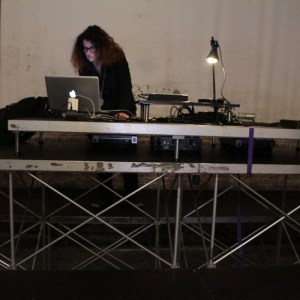

Missed this event to publicize it but the free download link is here.
Courtesy to Claire Guerin blog for this post.
Atelier Macumba
HB55 Kunstfabrik, Herzbergstrasse 55 (Eingang B)
Berlin-Lichtenberg
Tram M8, 21: Herzbergstr/Siegfriedstr
18:00 PÜNKTLICH!!!!
The participants in the SoundBoxes Workshop will present an immersive, surround-sound experience inspired by the works of Alvin Lucier, Pauline Oliveros, John Grzinich, David Tudor, Gordon Monahan and others, performed in a darkened room for an eyes-closed audience. In the piece, a swarm of individual, simple sound sources such as tones and textures are modulated and moved through the space physically by the performers to create a complex sonic environment. Delicate and intimate sounds pass closely near the bodies and ears of the audience, while stronger, more extreme sounds occur at the edges of the space to give a sense of the architecture of the room and the objects in it.
PLEASE ARRIVE AT 18:00 SHARP FOR THIS PERFORMANCE!
And then stick around for IPAs and a chance to demo some of theMacumbista.net
View original post 60 more words
This is the review –
Various Artists – Italian experimental underground 015 survey – volume II.
Courtesy to Yeah I Know it Sucks for this find.
As always, the review is quirky and to the point, which is refreshing and led me to these explorations into experimental electronic music, with some familiar names and some I am going to look up.
Here are a couple of artists on other compilations that you may be interested in –
Following on from the previous posts I visited the Electric Spring 2015 site and discovered the music of Isnaj Dui
So, I began with thoughts of focussing on Experimental Electronic Music and like most went down the route of the standard history that everyone charts.
As some of you by now will realise, although I do post a lot about the well known electronic artists, genres and histories, I also try to give those well under the radar a space to get their music heard or the genre a wider audience. This includes trying to bring to attention the scene in the rest of the world.
I had heard about Hugh Davies and his catalogue of ‘alternative electronic history’ but until today had not had a chance to explore further. So glad I did !
As I knew in my heart, there was and still is an alternative electronic music scene and one where many artists are quietly creating music unknown or ignored.
This is why I am reblogging this article as part of the Experimental Season, as many of the themes are still so relevant today and why Hugh Davies’ work is still vital as a challenge to the traditional historical theory.
Listening to the Soundcloud discussion is recommended as it gives an insight into roles of Daphne Oram ad Delia Derbyshire in the development of British electronic music and technology. Some interesting questions and answers.Here is the original overview of the concert and presentation on Daphne Oram and Delia Derbyshire –
In February 2015, a concert of tape music works by Delia Derbyshire and Daphne Oram was staged as part of the Electric Spring Festival at University of Huddersfield. The concert was preceded by a public conversation between the curator of the concert, Dr James Mooney, and one of the festival’s artistic directors, Prof Monty Adkins. A complete recording of this pre-concert discussion is now available via SoundCloud: click here.

The conversation addressed the context of electronic music in Britain in the 1950s and 60s and included discussion of Hugh Davies, his self-built instruments and – in particular – his International Electronic Music Catalog. The tools and techniques of electronic music production in the 50s and 60s were discussed, as was the institutional context of the BBC Radiophonic Workshop, where both Derbyshire and Oram worked.
While simultaneously extolling the challenges and contingencies of archival research, Mooney and Adkins discussed the work of some of the key figures in British electronic…
View original post 265 more words

“The story of the genesis and development of electronic/electroacoustic music is often told in the same familiar way. Experiments in musique concrète in Paris and elektronische Musik in Cologne played a central role in European developments, while activities in New York such as those of the Columbia-Princeton Electronic Music Center, John Cage and his Music for Tape-Recorders group, and Louis and Bebe Barron are frequently proffered as the most prominent American contributions. These activities were significant, of course; but they were not the only progenitors of modern-day electronic music. There are many, many other ways in which the story of electronic music’s history and development could be told…
For example… What does electronic music look like if we focus on the contributions of individuals whose work is less widely known; less widely recognised? What happens if we step away from the Western European and North American institutions that are normally figured as central to the genesis and development of electronic music?
There are many ways in which an ‘alternative’ history could be framed. The purpose of this conference is to explore all possibilities; to focus upon different ways of telling the story of electronic music; to explore its alternative histories.”
The above is a brief outline but does not cover all the themes that could be explored. Please visit the site for further detailed information.
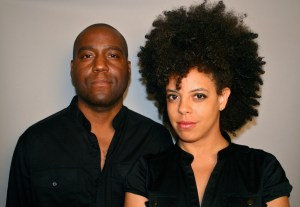
Here is the original piece which goes into detail about the theory and methodology behind the sound installations of Mendi and Keith Obadike.
SO! Amplifies: Mendi+Keith Obadike and Sounding Race in America.
Courtesy to SO! Amplifies for this article.
It’s Monday reblog time and here is a recent post from Sounding Out in celebration of World Listening Day 2015. I have been following the work of Mendi and Keith Obadike for some time as their art looks in detail at Race and Sound in America. I will repost the previous piece above from SO! Amplifies – recommended. Courtesy to Sounding Out for this post.
 For World Listening Day 2015, Sounding Out! is honored to debut Mendi + Keith Obadike’s new documentary video about their recent large-scale urban installation at The New School’s University Center in New York City, “Blues Speaker [for James Baldwin]” (April 2015), dedicated to writer and public intellectual James Baldwin (1924-1987). –JS
As Mendi + Keith describe, “For Baldwin sound, music, and the blues in particular were sources of inspiration. The multichannel sound art work meditates on a politics of listening found at the intersection of Baldwinʼs language and the sound worlds invoked in his work. It uses the glass façade of The New School’s University Center as delivery system for the sound, turning the building itself into a speaker. The 12-hour piece is created using slow moving harmonies, melodicized language from Baldwinʼs writings, ambient recordings from the streets of Harlem, and an inventory of sounds contained in Baldwin’s story…
View original post 291 more words
Today is World Listening Day and the focus this year is H20. Below is a wonderful post from World Listener in Japan and here is Feminatronics’ homage to Water.


Although it is very difficult to get hold of Teresa Rampazzis’ music you can hear samples of her work here.
Thanks to Laura Zattra for highlighting the Italian Pioneers of Electronic Music on her blog.







 Feminatronic
You must be logged in to post a comment.